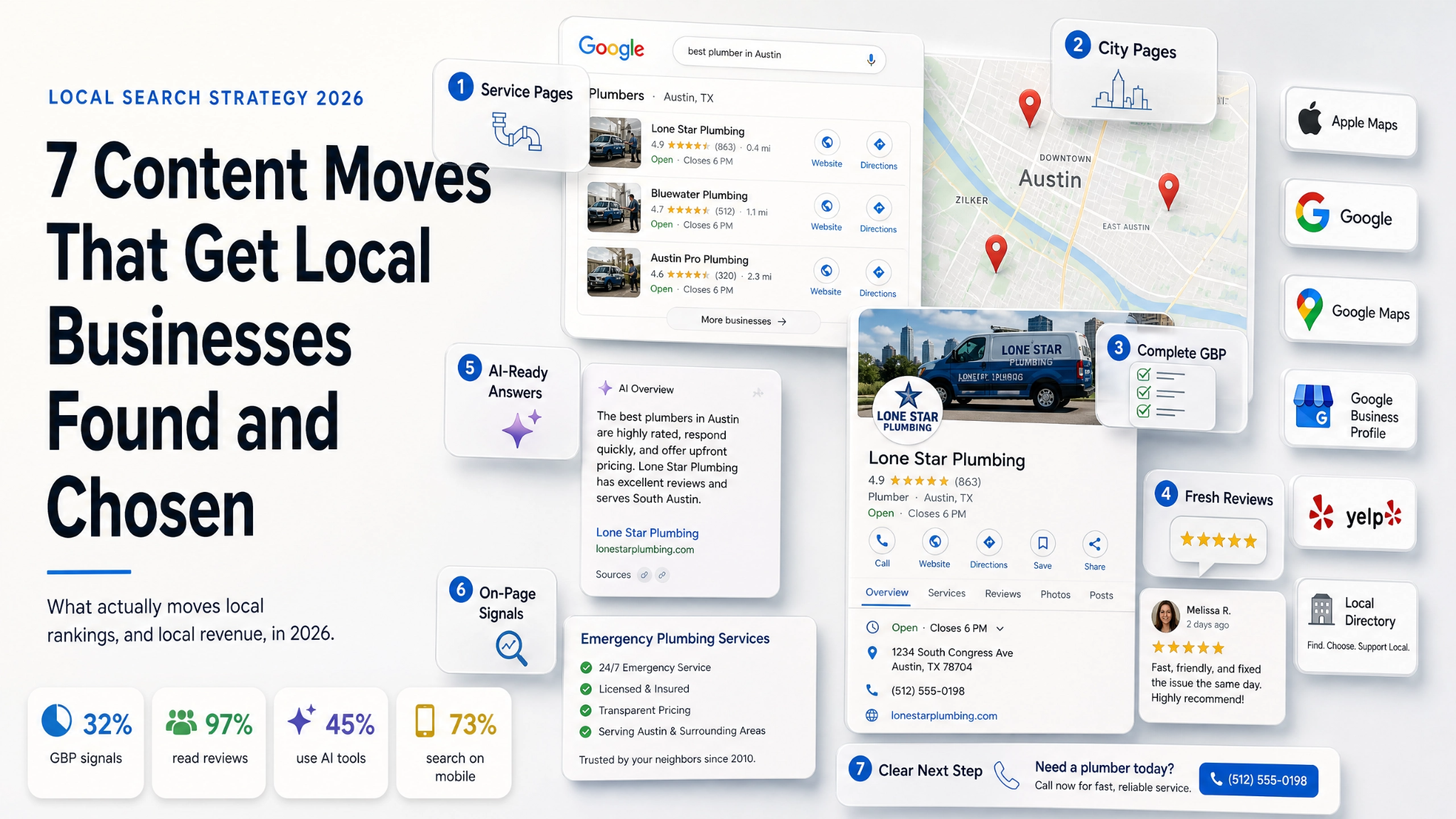
Local search stopped being a ranking contest. Between January and April 2026, 68% of US Google searches ended without a single click, up from 60% in 2024. Over the same stretch, 45% of consumers used AI tools to find a local business, up from 6% a year earlier. Seventy-three percent of local searches now happen on a phone, and 28% of people pick a business in under five minutes.
Showing up is no longer the win. Being the one they choose is. Here are seven moves that do both.
1. One page per service. No exceptions.
The 2026 ranking data puts a dedicated page for each service at the top of the local organic list. Not a bulleted services list. A page.
A plumber with a single “Services” page competes for nothing in particular. Separate pages for water heater replacement, drain cleaning, and burst pipe repair compete for three intents, each with its own urgency and price point. Predefined services inside your Google Business Profile climbed from position 81 to 22 year over year, so mirror your page titles in that service list word for word.
Do this: list every service you actually sell, then count your pages. The gap is your content calendar.
2. One page per city too, but only where you can prove it
Service pages tell Google what you do. Location pages tell it where. Geographic relevance is the second strongest local organic factor and an address in the searched city is the fourth strongest local pack factor, so your best pages are usually both at once: service plus city.
Service area businesses need one caveat. Proximity drives roughly 55% of local pack ranking decisions and you have one verified address, so you cannot publish your way into the 3-pack in a town forty miles out. Location pages win the organic results below the map, not the map itself. That is still most of the traffic, and it is the half you actually control.
The failure mode is the doorway page: one template with the city name swapped. Build a location page only when you can put at least three things on it that are true of that city alone. Completed jobs with photos. Reviews from residents there. County permit rules. Named neighborhoods. Your real response time to that postcode.
Do this: multiply your services by your priority cities, then build only the cells you can prove. Depth beats a forty-page matrix of thin copy every time.
3. Your Google Business Profile carries a third of the weight
Google Business Profile signals account for roughly 32% of the local pack factors you can control, up about 15 points since 2023. Review signals sit near 20%, on-page around 19%, links 15%, behavioral signals 8%, citations 7%.
The top local pack factors are blunt: primary category, proximity, keywords in the business name, an address in the search city, and, new to the top five, whether you are open at the time of the search. Hours and your service list are ranking assets. Profiles with photos pull 30% to 50% more views, and for service businesses 10% to 15% of profile views become a click to call.
Do this: audit your primary category, fill every predefined service, and add ten current photos.
4. Reviews are content, and they expire
97% of consumers read reviews. 41% always read them, up from 29% a year earlier. 68% will not use a business rated below four stars, and 31% now hold out for 4.5 or higher.
The part most owners miss: 74% only consider reviews written in the last three months, so a 200-review profile that stopped collecting last year reads as stale. 47% skip businesses with fewer than 20 reviews entirely. 89% expect the owner to reply and 81% expect it within a week, but 50% are put off by obviously generic replies. Businesses that respond to everything are 80% more likely to be chosen.
Do this: target two to five new reviews a month and write real replies, not templates.
5. Write so an AI can quote you
45% of consumers now use AI tools for local recommendations, ChatGPT at 31% and Google AI Mode at 23%. 82% read AI-generated review summaries and 23% decide from those summaries alone.
The good news: AI does not close the deal. Only 18% of AI users felt ready to contact a business an AI recommended, and 43% of those who started with AI went back to Google to check. AI shortlists, Google confirms, your site converts. To get quoted, put the direct answer in the first two sentences under a question-shaped heading, and keep pricing and service area in plain text rather than images. 73% of sites carry technical barriers that block AI crawlers, usually robots.txt rules, CDN restrictions, or JavaScript rendering.
Do this: add a short FAQ block with pricing ranges, service area, and response time to every service page.
6. On-page details still decide the close races
On-page signals carry about 19% of the local pack weight you control and sit in the top five for local organic. Four fundamentals do most of the work.
Page titles. Lead with the service, then the city, then the brand: “Emergency Drain Cleaning in Fresno | Rapid Plumb”. Title length is not a ranking factor. Clarity and the city name are.
Schema. LocalBusiness markup with name, address, phone, hours, and service area on every location page, plus Service and FAQPage markup on service pages. It is how machines confirm what your copy claims.
Internal linking. Link every service page to its matching city page and back, using anchor text that names the service. Orphaned service pages do not rank, no matter how well written.
NAP consistency. Identical business name, address, and phone across your site, your profile, and every directory. Mismatches are a silent ranking tax.
Do this: pick your five most valuable pages and fix titles, schema, and internal links on all five this month.
7. Make the next step impossible to miss
Average conversion rate across tracked industries is 5.13%. Organic search does better in local service categories: 8.1% for professional services, 7.3% for legal, 4.8% for construction and engineering.
Note how those conversions arrive. 56% of legal conversions and 53% of professional services conversions come through a phone call, not a form. Put a tappable number in the header of every page, visible without scrolling. Keep forms to name, phone, service, and postcode, because every extra field costs you leads, and state your response time next to the button. Speed decides the rest: average mobile load on 4G is 8.6 seconds against 2.5 on desktop, only 42% of mobile sites pass all three Core Web Vitals, and roughly 1% of conversion rate disappears per additional 100 milliseconds.
Do this: open your top service page on your own phone, on cellular data, and count the taps it takes to reach a human.
START HERE NOW
1. Count your services against your service pages. Build the biggest gap first.
2. Map services against priority cities. Build only the combinations you can prove.
3. Fill every predefined service in your Google Business Profile, using your page titles.
4. Fix titles, LocalBusiness schema, and internal links on your five best pages.
5. Ask your last ten happy customers for a review. Reply to every review you already have.
6. Add a question-shaped FAQ block with real pricing ranges to your top page.
7. Time that page on a phone, on cellular, and make the number tappable in the header.
Rankings follow relevance. Revenue follows the next step being obvious.