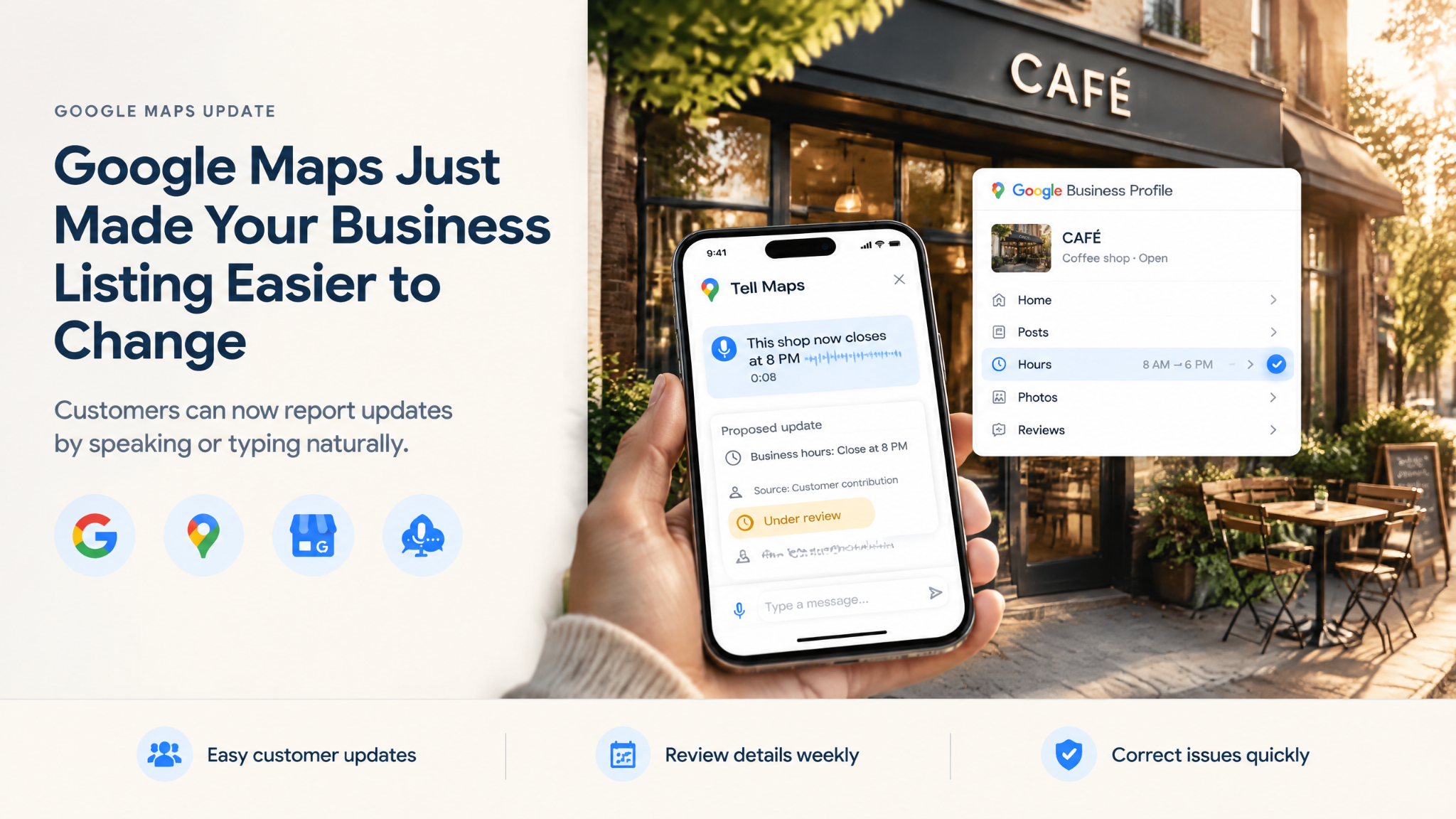
Customers can now report updates by speaking or typing naturally. We reviewed what Tell Maps does, where the risks sit, and what local businesses should do now.
Our Take Updating Maps is becoming easier for customers, so monitoring your Google Business Profile needs to become more disciplined.
Google has started rolling out Tell Maps, a conversational contribution feature inside Google Maps. It lets people report a change or share a local tip without working through the usual menus and forms.
We reviewed Google’s announcement and support documentation, the two industry reports shared with us, and an early real-world test. The opportunity is useful, but the risk is also clear: customers can now suggest changes with less effort.
The shift at a glance
500M+
Contributors help keep Google Maps current
300M+
Places feed the wider Ask Maps experience
97%
Of US consumers surveyed read local-business reviews
What Tell Maps actually does
A customer can type or say something like, “This shop now closes at 8 PM,” “There is more parking behind the building,” or “This place has closed.” Tell Maps can identify the business, structure the contribution, and guide it towards submission.
Google currently lists five supported actions:
- Report Business Hours
- Mark A Place As Closed
- Edit Place Attributes
- Share Local Tips, And
- Upload Photos
A user can also upload a photo of a storefront sign. Maps can read the hours shown in the image, then ask the user to confirm the suggested edit before submitting it. The feature is available through the Contribute tab and from an Ask Maps conversation. Google currently limits it to the US and documents the experience for Android devices.
Why this matters to your business
Tell Maps lowers the effort required to contribute. That can help your business when a customer shares useful information about parking, wheelchair access, payment methods, happy-hour times, or the best entrance. Google says these short tips may appear in areas such as the “Know before you go” panel.
The same low-friction process can produce incorrect updates. A customer may misunderstand your holiday hours, choose the wrong location, or report a temporary closure as permanent. Google says its protection systems review suggested edits for accuracy and policy compliance, so a spoken update does not automatically become fact. Still, no review system is perfect.
Recent customer information carries real weight. In BrightLocal’s 2026 survey of 1,002 US adults, 97% said they read local-business reviews, while 74% only cared about reviews posted within the previous three months. Tell Maps tips are not reviews, but the finding shows how strongly customers value fresh third-party information.
What early testing tells us
In an early field test, local search specialist Claudia Tomina found that Tell Maps could locate a listing, format a contribution, and prepare it for submission. Her tip remained under review rather than appearing immediately.
The test also exposed limits. Tell Maps could not locate one service-area business she tried to report, and it would not publish a review on her behalf. It provided a link so she could write the review herself. We see this as an important distinction: Tell Maps can reduce the work involved in contributing, but it is not a fully autonomous system that can publish every request.
Our five-step action plan
Audit the information customers depend on.
Check your name, address, phone number, hours, categories, services, website, attributes, photos, map pin, and service areas.
Monitor your profile every week.
Look for changed hours, new attributes, closure notices, customer photos, tips, and other edits. Check more often before holidays and seasonal changes.
Keep your public evidence consistent.
Your website, storefront signage, social profiles, booking pages, and directory listings should show the same core information.
Create a correction process now.
Decide who checks the profile, confirms the correct details, and submits corrections. Save screenshots and supporting evidence when a disputed change appears.
Keep earning recent, honest feedback.
Ask for genuine reviews without incentives or requests for positive comments. Tell Maps adds another stream of customer-generated information, but it does not replace reviews.
Our bottom line
Tell Maps is not a reason to panic, and we would not call it a confirmed ranking factor. Google has not said that customer tips directly improve or reduce local rankings.
The practical change is simpler: people can now tell Google about your business with less effort. Accurate businesses may benefit from richer information. Businesses that rarely check their profiles face a greater chance of customers seeing an outdated hour, an incorrect attribute, or a misleading tip first.
We recommend treating your Google Business Profile like your storefront. Keep it accurate, inspect it regularly, and correct problems before they influence a customer’s decision.