The drop is real
You are not imagining it. Roughly two out of every three Google searches now end without a click to any website at all. That number has been climbing for years, and AI Overviews, the answer box at the top of the page, pushed it higher.
When that box appears, the top-ranking result loses about a third of its clicks. Pew Research watched real people search and found the same thing from the other side: with an AI answer on screen, people clicked through to a website half as often.
The traffic did not go to a competitor. It stopped happening.
But local search is a different animal
Almost everything written about AI Overviews is written about publishers and blogs. Your customers search differently, and the pattern there is far kinder.
A study of hundreds of local searches across US cities and trades found a clean split:
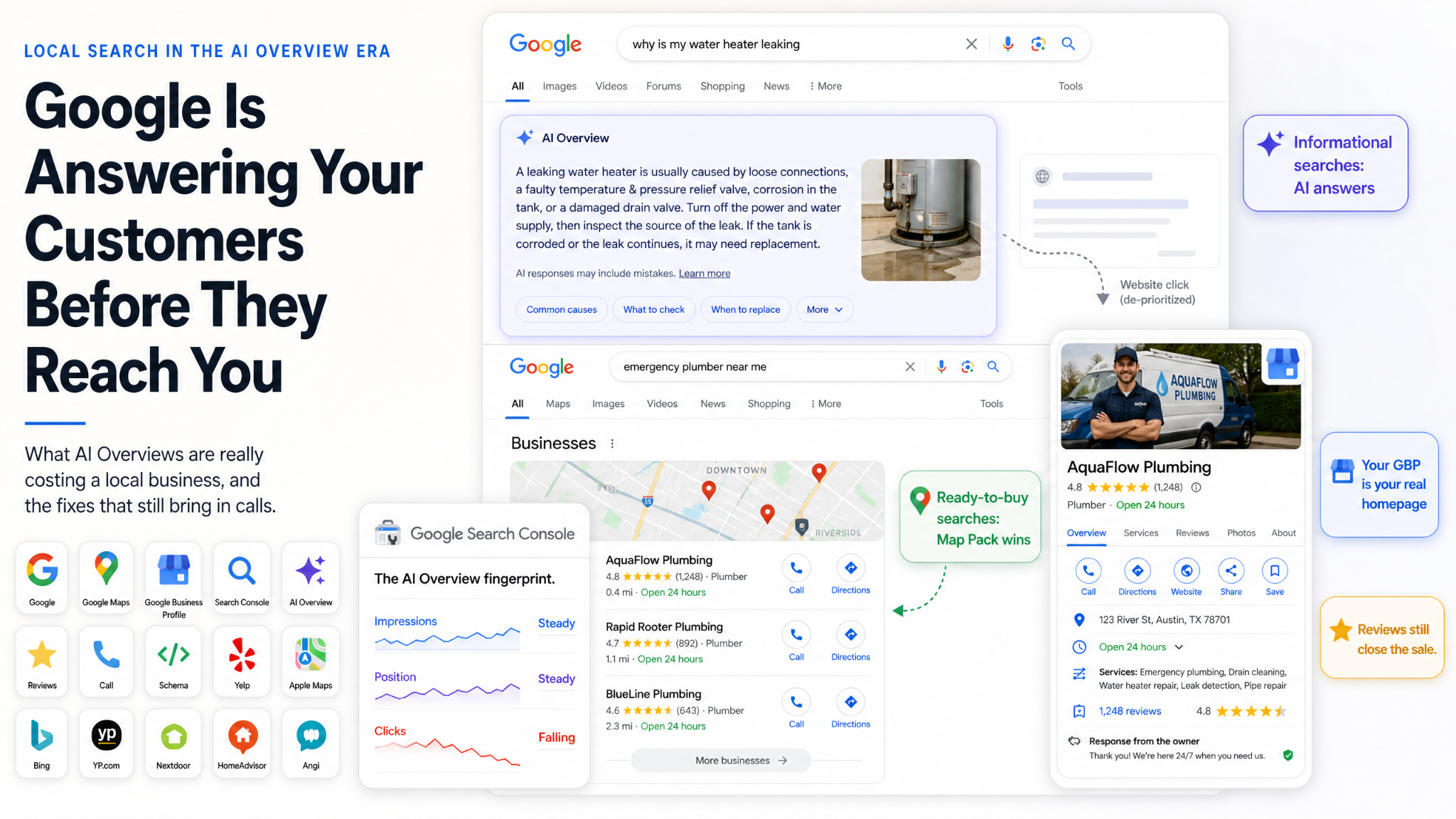
- When someone is ready to buy (“emergency plumber near me”), the map pack shows up almost every time and the AI answer box rarely does.
- When someone is just researching (“why is my water heater leaking”), it flips. The AI box answers over 90% of those and the map pack barely appears.
Read that twice. The searches that turn into phone calls are still largely intact. What is disappearing is article traffic, the “how much does it cost” visits that rarely booked anything anyway.
That should change what you worry about, and what you spend money on.
Check your own site in twenty minutes
Google gives you no report that says “AI Overviews took these clicks.” You have to read the fingerprint instead.
- Open Google Search Console, go to Performance, and switch on Clicks, Impressions, CTR and Average Position. Compare the last three months against the same period last year.
- Look for one pattern: impressions steady, position steady, clicks falling. That is the AI box. If your position dropped too, you have an ordinary ranking problem and a different fix.
- Split the pages into two piles: service and location pages in one, blog posts in the other. If the losses sit almost entirely in the blog pile, your money pages are fine and you can stop panicking.
Twenty minutes here saves you from rebuilding a website that was never the problem.
Five fixes, in the order that pays
1. Your Google Business Profile is your real homepage
The map pack wins the ready-to-buy searches, and your profile is what wins the map pack. Fill in every single field: categories, exact hours including holidays, your full services list, service areas, and price ranges. Add fresh photos every month. Answer the Q&A section yourself before a stranger does.
2. Reviews decide who gets picked
The bar has risen sharply in the last year:
- Nearly a third of people now refuse to use a business rated under 4.5 stars.
- Most ignore anything older than three months. Old reviews stop counting.
- Four in five expect a reply to every review, good or bad.
The practical version: ask three to five customers a week, every week. A steady trickle beats forty reviews in one month. Reply to all of them within a week.
3. Answer the questions, do not just list the services
If you want to appear in the AI box, be the page that answers the question cleanly. Give the direct answer in the first two sentences, then the detail. Publish real price ranges instead of “contact us for pricing.” Use short tables for costs and timelines. AI tends to cite recent pages, so revisit your key pages every few months and show the date.
4. Get mentioned where the AI is already reading
When AI answers a local question, most of what it cites is other people’s websites, not yours. You cannot win that by editing your own site alone. Keep your name, address and phone identical on Google, Bing, Apple Maps and Yelp. Then add the local layer: chamber of commerce, supplier and dealer listings, local news, sponsorships, and the community groups where your town actually talks.
5. Label your pages so machines can read them
Add LocalBusiness schema to your homepage and every location page: address, phone, hours, service area. Add FAQ schema to your question pages. This is a one-off job for whoever maintains your site, and it is the difference between a machine guessing your details and knowing them.
Where this is heading
A year ago, almost nobody asked AI for a local recommendation. Today close to half of consumers do, and among people in their thirties and forties it is far higher.
The reassuring part: almost all of them fact-check what the AI told them, usually on review sites. The AI mention starts the journey. Your reviews and your profile still close it.
DO THIS NOW
- Run the Search Console comparison and find out whether your money pages actually lost anything.
- Complete every empty field on your Google Business Profile and upload five current photos.
- Reply to every unanswered review, oldest first, then set a weekly reminder to ask three customers for one.
- Take your three best service pages and add a direct answer, a price range and a last-updated date.
- Check your name, address and phone on Google, Bing, Apple Maps and Yelp. Fix anything that disagrees.