The short version
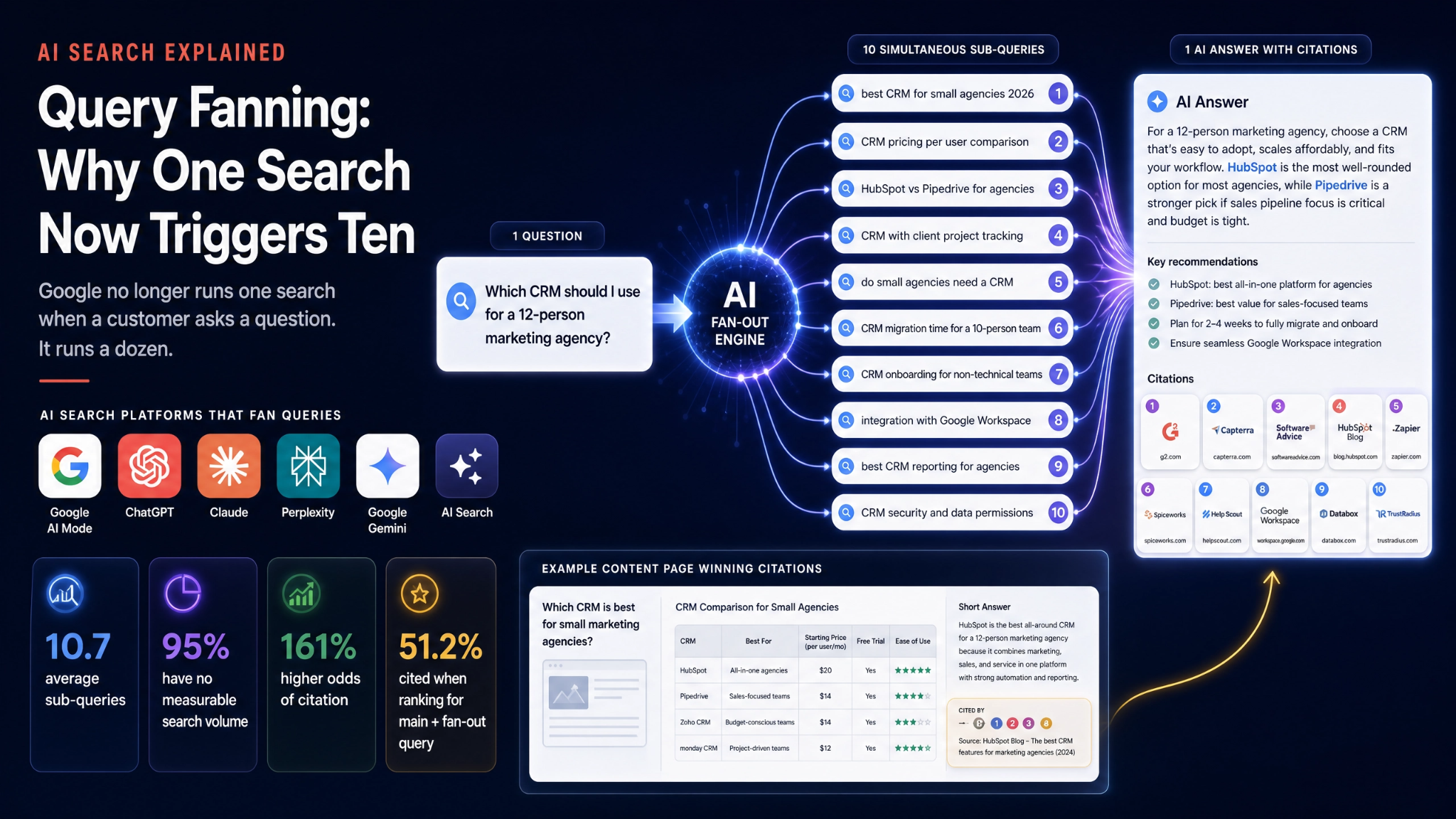
When someone asks a question in Google’s AI Mode, or triggers one of those AI summaries at the top of the results, Google does not run a single search. It quietly breaks the question into smaller sub-questions, runs a batch of searches at the same time, and writes an answer from whatever comes back.
Google calls this query fan-out. In its own words, published 20 May 2025: “AI Mode uses our query fan-out technique, breaking down your question into subtopics and issuing a multitude of queries simultaneously on your behalf.” For its Deep Search feature, Google says the system “can issue hundreds of searches.”
Query fanning is the industry’s shorthand for the same thing. It is arguably the single biggest change to how search works since Google started ranking links.
What it looks like in practice
Say a prospect searches: “which CRM should I use for a 12-person marketing agency”
Google does not simply hunt for pages matching that phrase. Behind the scenes it may run searches like:
- best CRM for small agencies 2026
- CRM pricing per user comparison
- HubSpot vs Pipedrive for agencies
- CRM with client project tracking
- do small agencies actually need a CRM
- CRM migration time for a 10-person team
You never see these. But the pages that answer them are the pages that get quoted in the final answer.
How many sub-questions? Seer Interactive ran 501 prompts through Gemini 3 in November 2025 and found an average of 10.7 sub-queries per prompt, ranging from 3 to 28. The same test on the older Gemini 2.5 averaged 6.01, a 78% jump in one model generation. Ahrefs reports Google AI Mode typically fires 5 to 11.
Here is the part most people miss: 95% of those sub-queries had no measurable search volume. They are not keywords sitting in a keyword tool waiting to be found. They are questions the machine invents on the spot.
WHY THIS IS NOT A NICHE TECHNICAL TOPIC
1 billion monthly active users on Google AI Mode, reached within a year of launch. Sundar Pichai, Google I/O keynote, 19 May 2026
7.22 vs 4.0 average words in an AI Mode query versus a traditional Google search, across 69 million US desktop sessions. Semrush, May–July 2025
53% vs 8% share of searches producing an AI summary for queries of 10+ words versus 1–2 words. Pew Research, 68,879 searches, March 2025
8% vs 15% of visits where users clicked a normal search result, with an AI summary present versus absent. Just 1% clicked a link inside the summary. Pew Research, July 2025
40% of small businesses report traffic disrupted by algorithm changes and AI, rising to 46% at 11–100 employees. LocaliQ survey of 300+ SMBs, March 2026
Put those together and the picture is clear. Search is becoming more conversational. Conversational searches pull in more AI answers. AI answers send fewer people to websites. Query fanning is the machinery sitting in the middle of all three.
The number that should change your content plan
Surfer SEO published the most useful study on this in December 2025. They took 10,000 keywords, analysed 173,902 URLs, and used Gemini to extract 33,000 fan-out queries. Three-quarters of those keywords (76%) triggered an AI summary.
The headline finding:
- Pages ranking for the main query only accounted for 19.6% of AI citations.
- Pages ranking for the main query and at least one fan-out query accounted for 51.2%.
That is a 161% lift in the odds of being cited. The correlation between how many fan-out queries a page ranked for and how often it got cited was 0.77, which is strong.
The second finding is the encouraging one if you are not the biggest name in your market: 67.8% of cited pages did not rank in the top 10 for either the main query or its fan-outs. You do not have to be number one to be quoted. You have to be the page that genuinely answers the sub-question.
And being quoted pays. Seer Interactive found brands cited in AI answers earn roughly 120% more organic clicks per impression than brands that are not.
Five things to do about it
- Answer the whole question, not the keyword. Before publishing anything, write down the 10 to 15 follow-up questions a real buyer would ask: cost, timeline, alternatives, who it suits, who it does not, what typically goes wrong. Cover them on the page, or across pages you link together.
- Write so a machine can lift a passage. Use the question as your heading, then answer it in the first two or three sentences underneath before you expand. Tables, short lists and clear headings get extracted. Long unbroken prose does not.
- Be specific and current. In the Seer test, 21.3% of fan-out queries included a year and 26.4% included a brand name. Vague evergreen copy matches neither. Name products, name competitors, cite figures, date your content.
- Build clusters, not one-off posts. Do not chase individual fan-out queries. Surfer found only 27% of them stay the same when the identical question is asked again, so they are moving targets. What stays stable is depth of coverage on a topic.
- Publish the boring facts. Prices, service areas, opening hours, specifications, warranty terms, comparison tables. Fan-out queries constantly ask for these attributes, and most business websites bury them or leave them out entirely.
What to measure instead
Keyword rankings alone will stop telling you much. Add three things: how often you get cited in AI answers for your core topics, your branded search volume (a rising line means the answers are working even when the clicks are not), and the conversion rate of AI referral traffic, which is small in volume but tends to arrive much further down the funnel.
Bottom line
Query fanning turns one customer question into a dozen. The winners are not the sites with the best single keyword match. They are the sites that credibly answer the most of those dozen, in a format a machine can quote. That is a content depth problem rather than a technical one, and it is solvable by any business willing to write down what it already knows.